Why Keep Your Yarn Labels

I've seen it time and time again. You're beginning a new project and you're excited, so you rip that yarn label off, find the end and get started. What do you do with the label? It feels like garbage, right? We typically throw out packaging so that makes sense. But there is important information on that label that you may need later in your project so ..

... don't throw it out yet.
Read on for my five reasons to save your labels.
Before we get to those, let's start with a little background info. If you haven't heard the story before, when I opened Ladner Village Arts & Crafts (RIP) I was the paper crafting half of the partnership. I had little to no interest in knitting or crochet, or anything remotely related to knitting and crochet! When I saw the public's interest and the growth of that side of our business I knew I needed to take an interest and my journey to where I am today started.
To say I dove head first into the deep end is a bit of an understatement. Through a baffling combination of circumstances, need, and a personal discovery of both talent and passion for crochet, I went from student to teacher in 4 short months. Let that sink in!
My deep dive involved many hours on YouTube watching how others crocheted, and on blogs learning about different stitches, techniques, and yarns. I know that not everyone has my nerdy tendencies, which is completely fine. As an instructor, it makes sense for me to go deep on subjects that others would find dull, and pass along what I've learned in bite sized pieces.
I found designers I liked, bought more patterns than one person should (still happening, let's be honest), and spent hours practicing stitches. I had massive failures along the way (hello to the cardigan that ended up roughly big enough to fit Andre the Giant!) but I persevered because I'd found a hobby that clicked for me like nothing had in a long time.
What does all this have to do with yarn labels?
I'm getting there.
One of the resources I found and reference all the time, is the Craft Yarn Council. This is an organization with an extensive website full of information designers use to determine things like sizing for blankets and garments, and standardized abbreviations for crochet and knitting stitches. But the average crocheter and knitter can also visit this site for valuable resources too. Like what all those symbols on your yarn label mean.

As my interest and knowledge of the fibre world grew, I started making the purchasing decisions for the store and trying out new yarns as they arrived. It kind of led to a stupid amount of knowledge about yarn!
This in turn led to me doing a 'yarn tour' during our Crochet Basics 2.0 class, where I introduce our students to all the different yarns in my inventory and talk about their weights, their composition, and give ideas of what projects they are ideal for. In their workbooks is an image similar to this one.
We don't do this tour during our 1.0 class because it's too overwhelming. Learning to hold a hook and yarn and make stitches is about all the average beginner can handle. When you start throwing terms like 'worsted weight' and 'recommended hook size' at them their eyes glaze over. We do talk about it when it comes up, but primarily our goal is to get our beginners comfortable with the basic stitches and basic pattern reading skills. The rest comes as their interest for the craft grows.
Okay, it's time for those 5 reasons to keep your yarn labels that I promised you.
Know Your Dye Lot
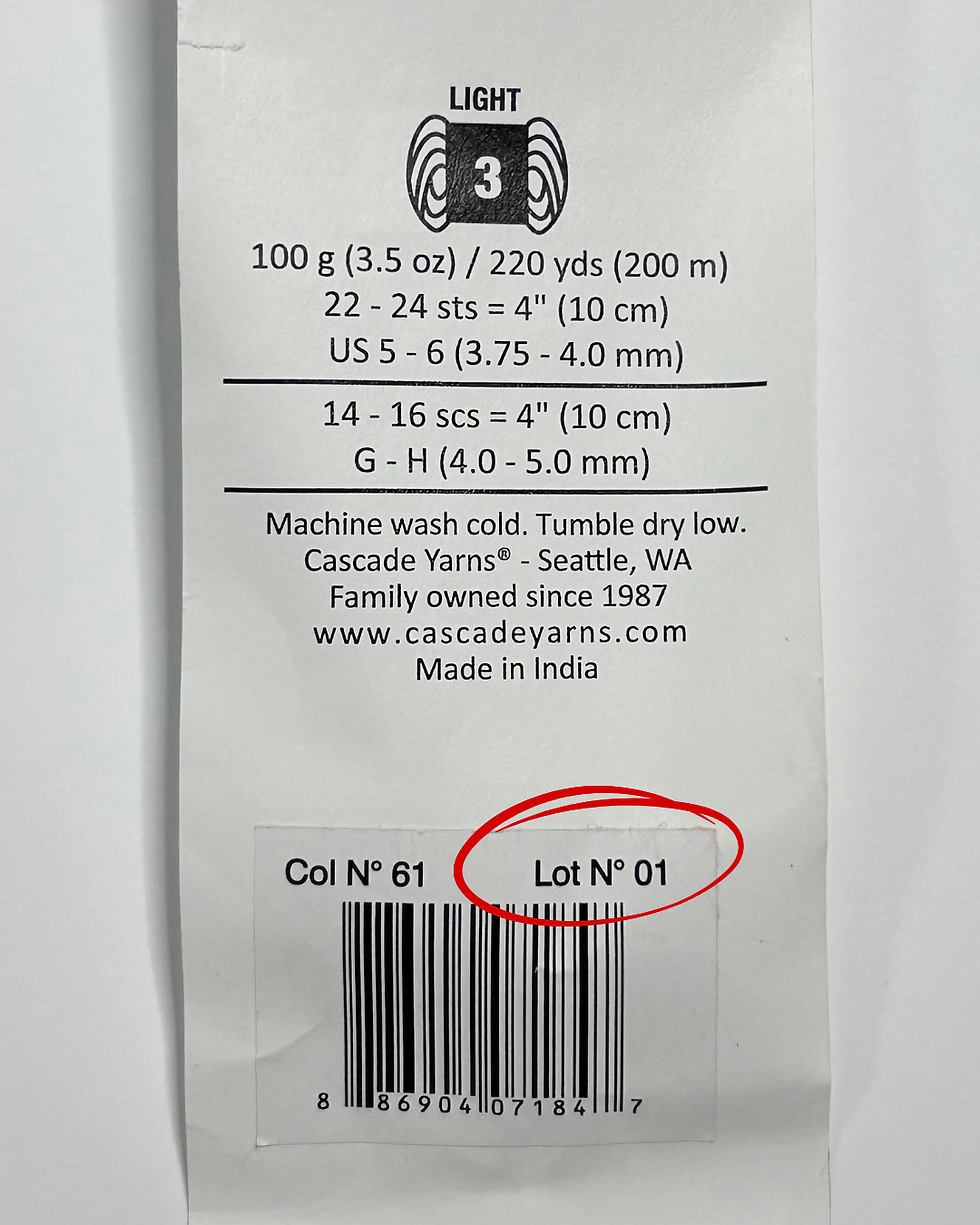
Have you ever started a project only to realize you need more yarn so you run to your local yarn or craft store for more. Thank goodness they had some and in the same colour! But as you continue you feel like something is 'off'. The colour isn't quite right. You check your label to make sure you purchased the correct colour, only to be reassured that you did.
So what's wrong?
More than likely your new ball is from a different dye lot.
For large brands that pump out thousands of balls of one particular colour, you may not give a moments thought to whether or not every ball is exactly the same shade of its stated colour. But depending on when your ball was dyed, it can make a big difference. And for smaller, hand dyed, or small batch dyers, it can make a huge difference.
Dyes are mixed up in batches. While there is a recipe that the dyer follows (and larger companies would use programmable machines to ensure consistency), it's easy to add an extra millilitre of one colour by accident. Or, as every baker knows, it's more or less humid on the day you dye the second batch. Stuff happens!
Keeping your label and making sure any new balls of yarn added to your project are from the same dye lot will save your sanity! Want a real world, real designer example? Listen to Ali from the Turtle Trunk tell you about the time she ripped out over a thousand stitches to fix a dye lot issue. Yep. The pain is real!
Know Your Colour Name or Number
Not all yarn labels are created equal. Some companies put the colour name and number on the ball band, others only put the number. (Why? Who knows but as a small time yarn reseller it's a bit annoying.) Here are three examples from my inventory showing three different ways to deal with labelling yarn.
Starting on the left, we have an example of our most popular yarn, Cascade Anthem. Both of these balls are the colour Nimbus Cloud but please note that they are different dye lots. Is there a colour difference? It's next to impossible to show accurate, real life colours on a screen, and looking at them in person I'd say no. But, like what happened to Ali in the reel I linked above, a slight colour difference may not show up until you're rows into the project.
One of these labels has one of my price stickers on it with the colour name. If you bought that ball, you might remember that you were working with the colour Nimbus Cloud, but would you remember that you were working with colour number 72? Doubtful. And if you went back to the store with only "it's a light grey" you might go home with a completely different grey called Silver.
The other two examples above both state the colour name on the label which is so helpful. But, if you were to lose that ball band, would you look at your yarn or your project and know that you were working with something called 'cosy navy' or 'rainbow'? Names can be a little deceiving when you look at the yarn in question.
Lesson here, keep the label so you can make sure you get the correct additional yarn to finish your project - in both colour and dye lot!
Know How Much You Used
I can't count the number of times I've been asked "how much will I need to buy?" My typical answer?
"That depends."
First you need to know what project you're working on, and what the pattern calls for. The designer will have stated how much yarn they have determined you need for each size the pattern comes in. (They will also have determined a weight of yarn, and depending on the project, a gauge you need to meet - but those are issues for another day.) To figure out how many balls you need to buy to make your project, you'll need your yarn label.

This is the same label I shared earlier but this time let's look at a different part of it. Each ball, hank, cake, or skein of yarn should be labeled with its weight and how many yards or metres are expected. This label shows that for every 100g, you can expect to get 220 yards of yarn.
So let's say you were making a project with this yarn and the pattern calls for 800 yards, you'd need 4 balls to complete your project (800 / 220 = 3.64 or 4 balls). As you're making it, you decided to make your project bigger, so how many more balls of yarn do you need to buy? Check your pattern first and re-do the math to find your answer.
But what if you're working on a pattern that either doesn't have defined yardage, or is so easily adjusted that you can keep going until it's a big as you want it to be. Many blankets are like this. You get in the crochet groove and just go until you feel it's done, buying more yarn as you need along the way. Once you've finished your project, a friend compliments you and decides they want to make the exact same blanket. How will you know how many balls of yarn to tell them to get?
If you kept all your yarn labels it would be as easy as counting them up!
You can also weigh your finished project and do some math that way, but again, you'll need at least one label that tells you how many yards per gram your yarn has.
See what I mean? There's more information on those labels than you think.
Dealing With Your Leftovers
We have talked a lot on this blog about WIPs and yarn stashes, but what about the bins of yarn leftovers? What do you do with those? And if you have no labels, how do you know what yarn it was, what colour it was, or what you made with it in the first place?
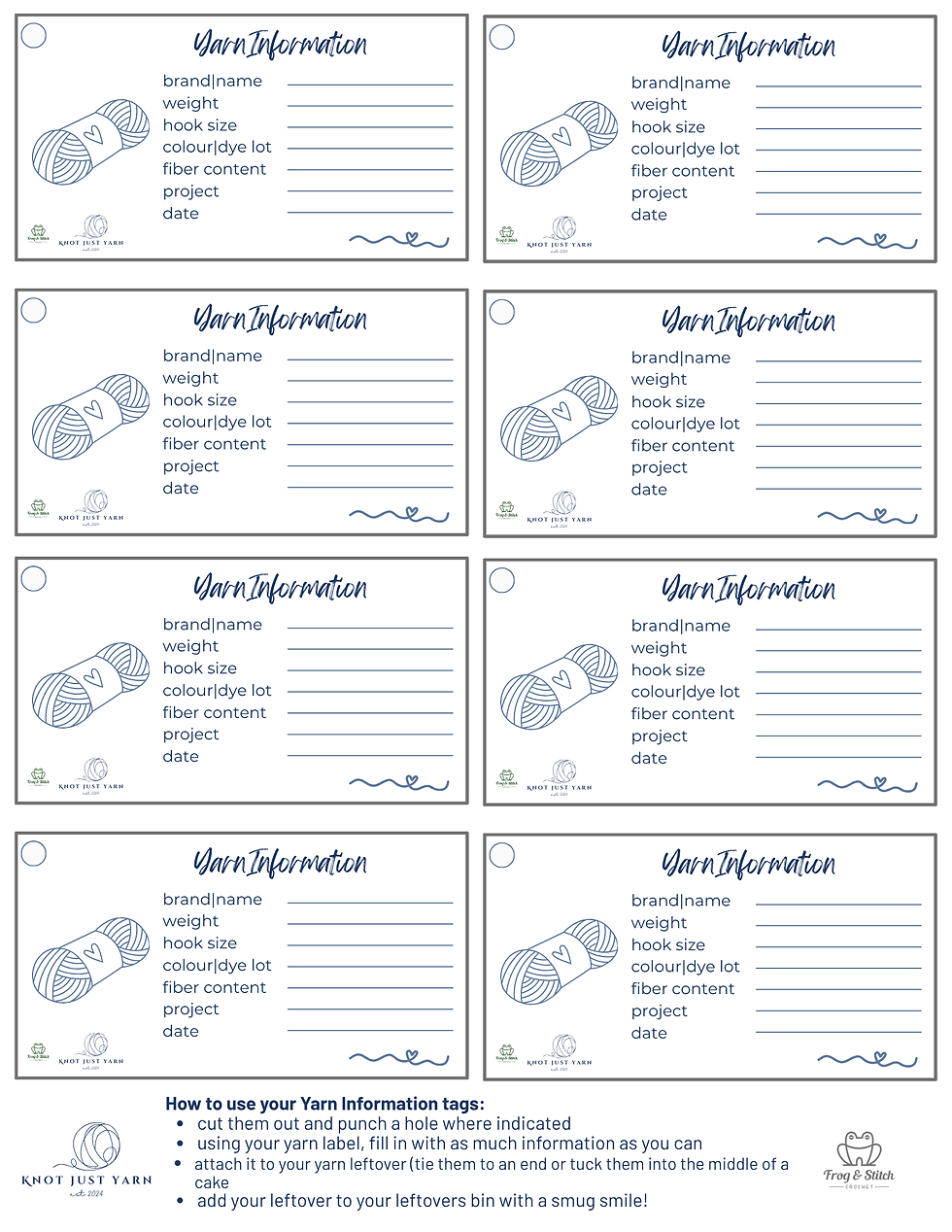
This is another one of our extras that all our beginner students receive and now you can have it too. Before you throw out those labels, jot down the brand, yarn name, colour name and/or number, dye lot, what you made with it, what size hook (or needles) you used, and when you used it. (If you remember, when you bought it too!) Attach it to your ball of leftovers and throw it into your bin safe in the knowledge that should you need to mend a project, or should you want to make a scrap blanket out of all your acrylic leftovers, you can easily find what you're looking for.
Keeping Track of Consumption
This last tip or reason to keep your yarn labels is a bit ... out there. But bear with me!
Ever wondered how much you've knit or crocheted in a month, or year? Not only how many projects you've completed, but how many balls of yarn you've used? How would you keep track of that?
Book lovers share on Instagram or add them to their Goodreads page.
Scrapbookers tend to have albums you can flip through proving how many layouts they made that year.
For knitters and crocheters, we can add all our projects to Ravelry, that's a great way both to keep track and share with the wider community.
We could make a post where we try on everything we've made, or do one of those blanket roll reveals for Instagram.
You could keep a notebook of all your projects - kind of like a gardener's journal. I LOVE a notebook, so this one is kind of speaking to me, won't lie!
But you know what would be kind of fun ... keeping them in a giant jar or basket and dumping them out to admire the sheer audacity of it all!
Okay, this one was a bit tongue in cheek, but I hope I've managed to convince you that keeping your yarn labels, at least until you've finished your project, is a good habit to get into.
I'll leave you with one last example.
I made a massive waffle stitch blanket for my youngest and I wanted to keep track of not only how many balls of each colour I was using, but how long it took me to crochet. Here is the reel I posted to Instagram and my final numbers.
Yarn used: Cascade Anthem 100% acrylic yarn in Dust Lavender (colour No.74) - 13 balls, Black (colour No.05) - 11 balls, and White (colour No.08) - 10 balls
Number of stitches per row - 225
Number of rows - 212
Plus a border consisting of one round single crochet, one round puff stitches, and one final round single crochet.
Finished width = 60”/152.4 cm
Finished length = 82”/208 cm
Approximate number of hours to complete: 86 hours
Kind of mind blowing, right? And the stack of labels at the end of this project was truly something to behold.
So do you keep your labels? For how long? And what do you do with them once you've finished the project? Let me know in the comments.
Comments